AI testing is becoming an important part of modern software quality assurance. As software teams release faster and applications become more complex, QA teams need better ways to design, execute, maintain, and analyze tests at scale.
However, AI testing does not simply mean “using AI to test software.” The rise of AI testing is also reflected in recent research. A systematic review of AI-powered test automation tools analyzed 55 AI-based testing tools, while another multi-year grey literature review on AI-assisted test automation examined more than 3,600 grey literature sources, filtered 342 relevant documents, and cataloged 100 AI-driven test automation tools.
These studies show that AI is no longer a theoretical concept in QA; it is becoming a practical response to common automation challenges such as test generation, maintenance, and self-healing test scripts.
For teams already investing in test automation, AI works best when combined with a structured automation foundation. TestArchitect helps QA teams build scalable, reusable, and maintainable automated tests through codeless, action-based automation. Its AI-powered assistant and smart automation capabilities can support onboarding, test optimization, failure troubleshooting, locator creation, and project-level insights.
What Is AI Testing?
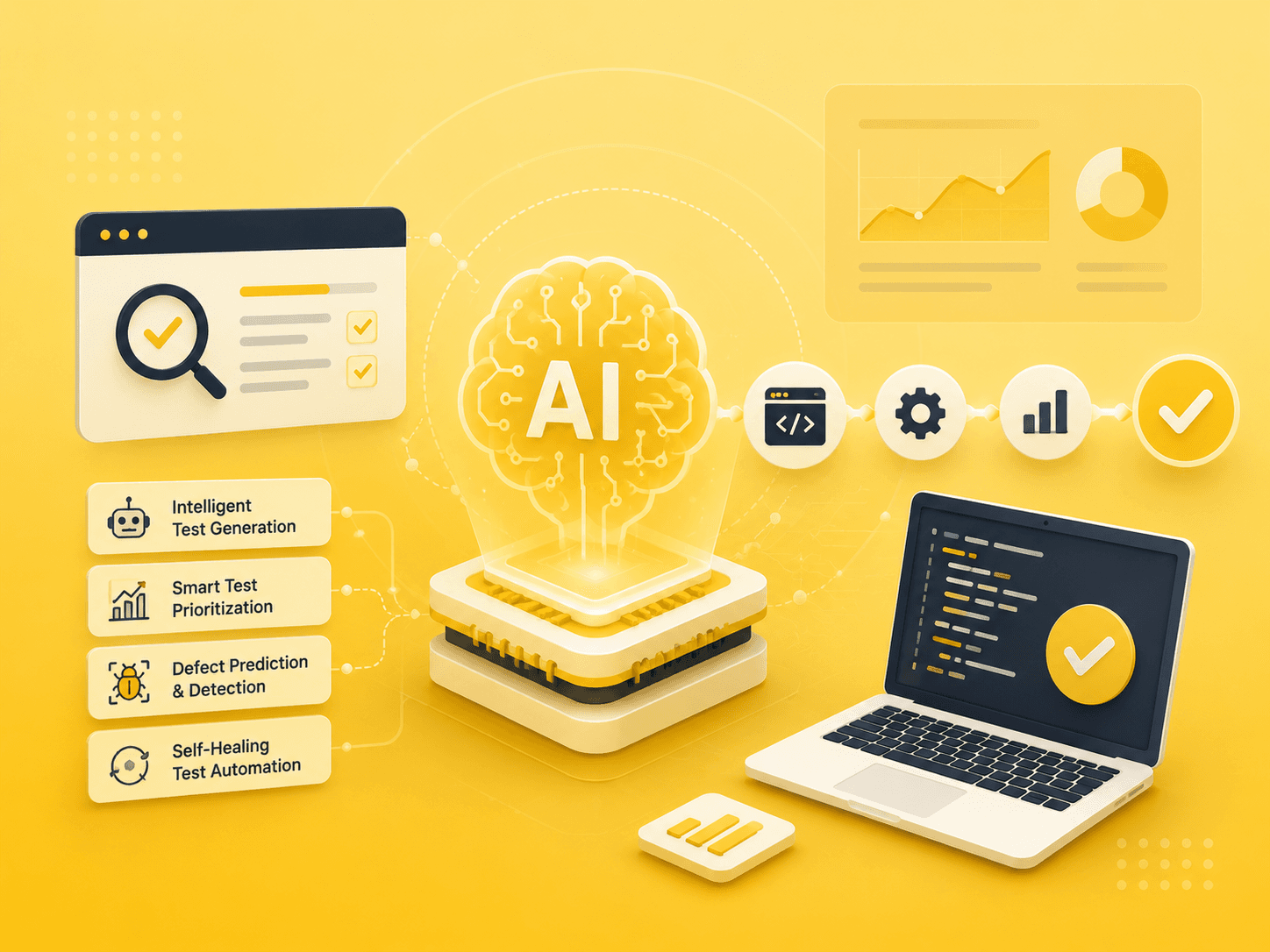
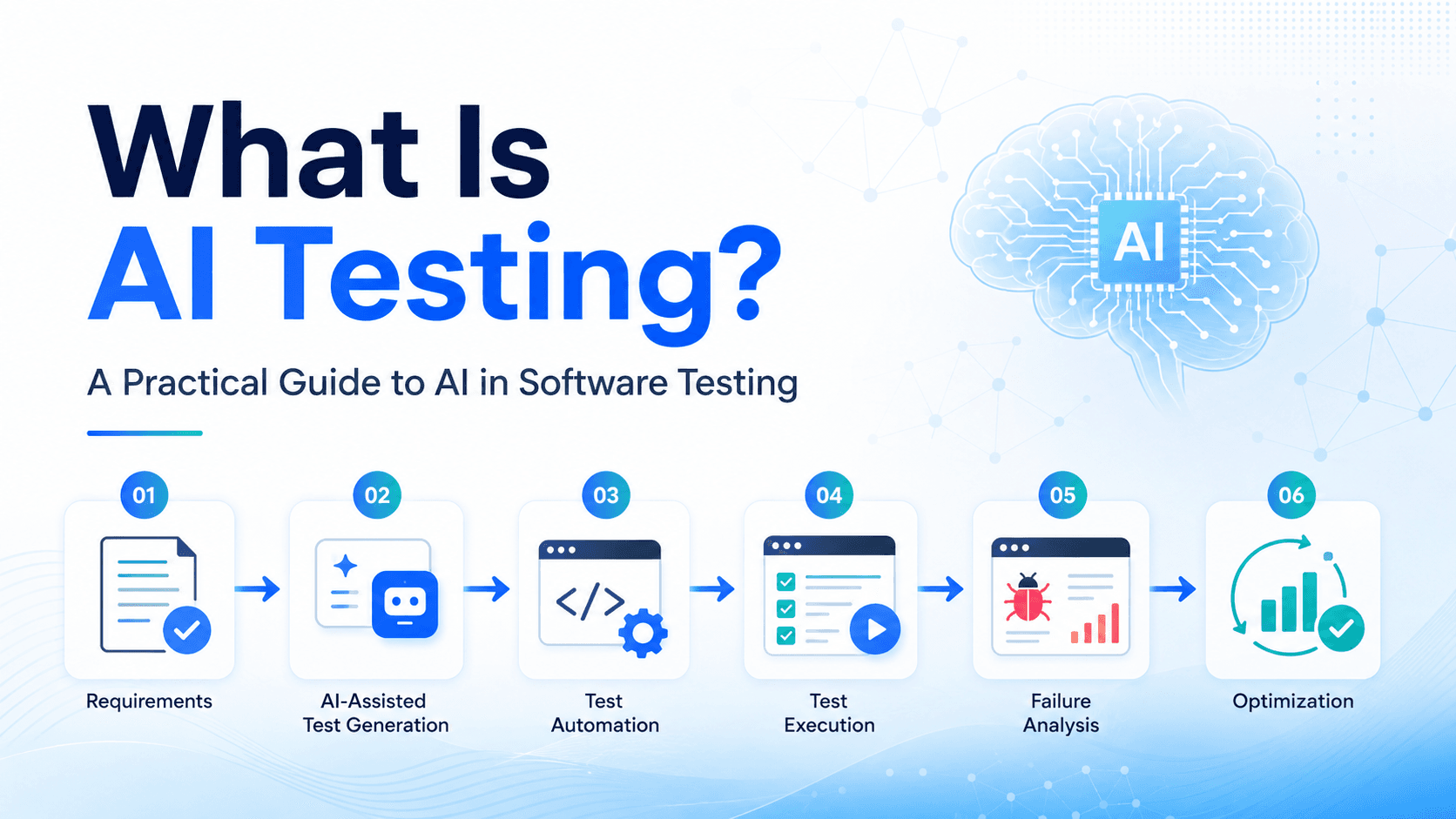
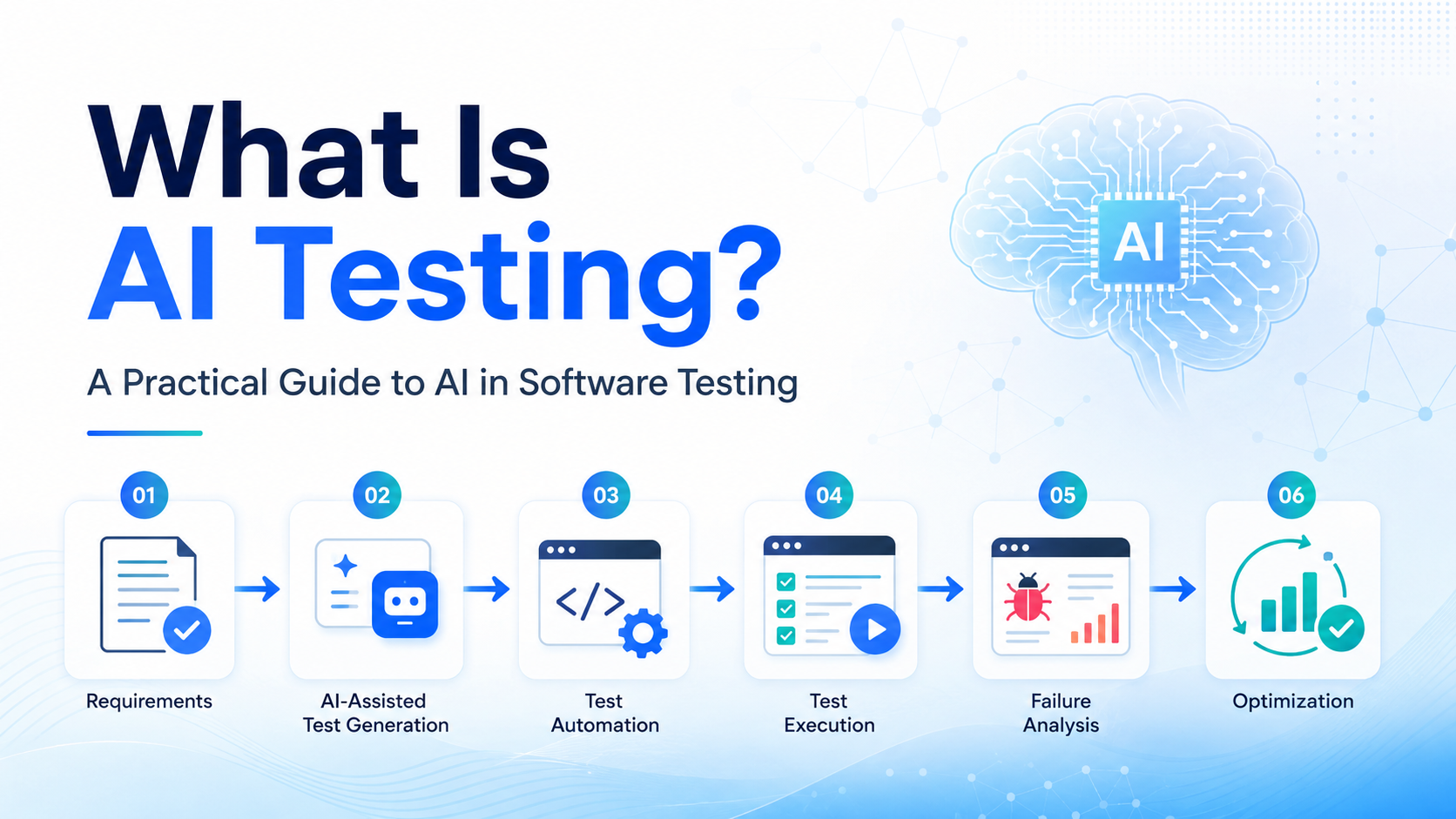
AI testing is the use of artificial intelligence in software testing to improve how tests are created, executed, maintained, and analyzed. Instead of relying solely on manually written scripts or static test cases, AI can help QA teams identify patterns, generate test scenarios, adapt to application changes, and improve test automation efficiency.
In practical terms, AI testing can support activities such as:
- Generating test cases from requirements or user stories
- Suggesting edge cases and missing scenarios
- Maintaining automated tests when the application changes
- Prioritizing regression tests based on risk
- Detecting flaky tests or recurring failure patterns
- Analyzing test results faster
- Supporting test data generation
AI testing does not replace QA engineers. It helps QA teams reduce repetitive work, improve productivity, and focus more on test strategy, risk analysis, exploratory testing, and business-critical validation.
Why Is AI Becoming Important in Software Testing?
AI is becoming increasingly important in software testing as traditional QA processes face increasing pressure. Agile, DevOps, and CI/CD have shortened release cycles, requiring testing to happen faster and more frequently.
In CI/CD environments, automated testing is part of the software delivery pipeline, where code changes are built, tested, and released more frequently. This increases pressure on QA teams because slow, unstable, or hard-to-maintain tests can directly affect release speed and confidence.
At the same time, applications are more complex than before. QA teams often need to validate web, mobile, desktop, API, and enterprise systems across multiple environments. Manual testing alone cannot scale efficiently in this context.
Traditional test automation helps, but it also has limitations. The maintenance problem is measurable. According to the Google Testing Blog’s analysis of flaky tests, about 1.5% of all test runs reported a flaky result, almost 16% of tests had some level of flakiness, and about 84% of pass-to-fail transitions involved a flaky test.
For a project with around 1,000 tests, even a 1.5% flaky rate could mean roughly 15 tests requiring extra investigation before release. This illustrates why QA teams need better ways to detect, analyze, and reduce unreliable automated tests.
Automation scripts can become fragile, especially when user interfaces change. Test maintenance can consume significant effort. Large regression suites can take too long to execute. QA teams may also struggle to identify which tests are most important for each release.
AI can help address these challenges by making testing smarter. It can assist with test generation, maintenance, prioritization, and analysis. But AI works best when applied on top of a robust testing process and a scalable automation framework.
This is where a platform like TestArchitect can support enterprise QA teams. TestArchitect provides a structured approach to test automation, helping teams build reusable test assets and manage large-scale regression testing more effectively.
How Does AI Testing Work?
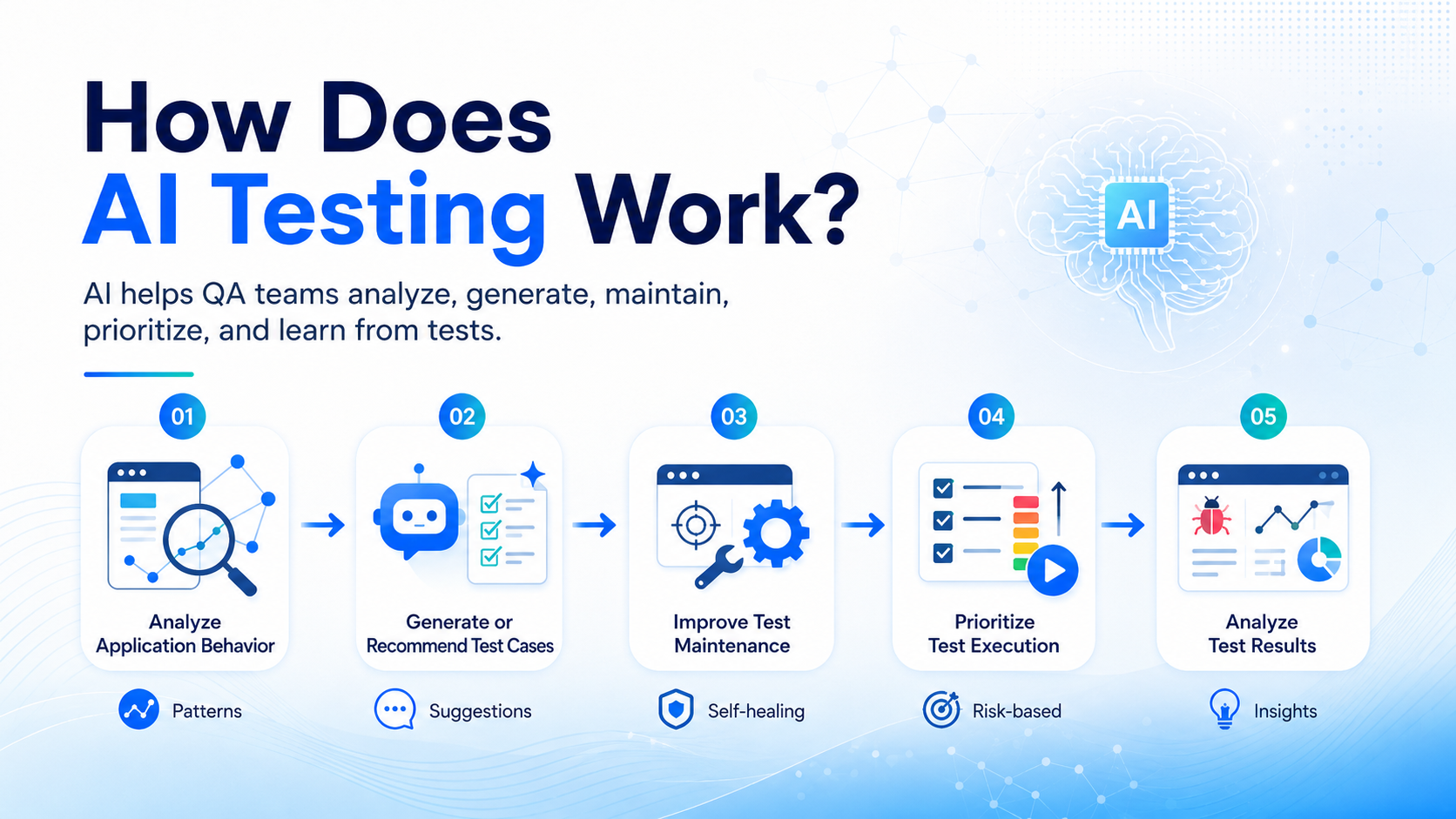
AI testing uses machine learning, natural language processing, pattern recognition, and other AI techniques to support software testing. The goal is not only to automate test execution, but also to make the testing process more intelligent.
AI Analyzes Application Behavior
AI can analyze user flows, application behavior, test history, logs, and past defects to identify patterns. This helps QA teams understand which areas of the application may pose a higher risk or require greater test coverage.
For example, if a specific module has historically produced more defects, AI can help prioritize tests related to that module in future releases.
AI Generates or Recommends Test Cases
AI can help generate test cases from requirements, user stories, specifications, or existing test assets. This is often referred to as AI-generated testing or AI-generated test creation.
This is why AI-generated test cases still require structured review. A systematic review of requirements-driven automated software testing analyzed 156 papers and found that automated test generation remains constrained by scalability, automation gaps, and reliance on the quality of input requirements.
In practice, AI can accelerate test design, but weak requirements can still lead to weak tests.
For QA teams, this can reduce the time required to create initial test coverage. However, human review is still necessary. AI-generated tests may miss business context, misunderstand ambiguous requirements, or create redundant scenarios.
AI Improves Test Maintenance
One of the biggest challenges in test automation is maintenance. When an application changes, automated tests can fail because object locators, UI elements, workflows, or test data are no longer valid.
AI can help identify changes and suggest updates. In UI testing, for example, AI may help recognize elements even when their attributes or positions change.
This can reduce the effort required to maintain automated tests, especially in fast-changing applications.
AI Supports Smarter Test Execution
AI can help QA teams decide which tests to run based on risk, code changes, historical failures, or business impact.
Instead of running every test case every time, teams can use AI-assisted prioritization to focus on the most relevant tests for a specific release.
This is especially valuable for large regression suites, where full execution may take too long.
AI Analyzes Test Results
AI can also help analyze test results. It can group similar failures, identify recurring patterns, detect flaky tests, and suggest likely root causes.
This allows QA teams to spend less time reviewing raw reports and more time resolving meaningful quality issues.
6 Common Use Cases of AI in Testing
AI can be applied across many areas of software testing. The most common use cases include test case generation, test automation, regression testing, UI testing, defect prediction, and test data generation.
1. AI for Test Case Generation
AI can help QA teams create test cases faster by analyzing requirements, acceptance criteria, user stories, or existing documentation.
For example, AI may suggest:
- Positive test scenarios
- Negative test scenarios
- Boundary value cases
- Edge cases
- Missing validation checks
- Alternative user flows
This can be especially useful when QA teams need to quickly establish test coverage during early sprint planning or requirement review.
However, AI-generated tests should not be accepted blindly. QA engineers still need to validate whether the suggested scenarios are accurate, relevant, and aligned with business logic.
2. AI Test Automation
AI test automation refers to using AI to improve or assist automated testing. This may include generating automation steps, identifying objects, adapting to UI changes, analyzing failures, or recommending which tests should run.
In practice, AI test automation works best when paired with a structured automation framework. Without structure, teams may generate more tests but still struggle with maintenance, duplication, and inconsistent execution.
TestArchitect supports scalable test automation through Action-Based Testing, using reusable, keyword-driven actions that make automated tests easier to read, build, and maintain.
Its AI-powered assistant can provide contextual guidance, best-practice recommendations, optimization suggestions, and failure troubleshooting, while tools such as TestArchitect UI Mapify help teams create more reliable locators for web automation.
3. AI for Regression Testing
Regression testing is one of the strongest use cases for AI in software testing. Large applications often have hundreds or thousands of regression test cases. Running all of them for every release can be time-consuming.
AI can help by identifying which tests are most relevant based on:
- Recent code changes
- Historical defect data
- Failed test patterns
- Business-critical workflows
- High-risk modules
This allows QA teams to optimize regression testing without losing control over release quality.
For enterprise QA teams, combining AI-assisted regression prioritization with a platform like TestArchitect can help improve both test coverage and execution efficiency.
4. AI for UI Testing
UI tests are often fragile because user interfaces change frequently. A button may move, a field name may change, or an object locator may be updated. These changes can cause automated tests to fail even when the application still works correctly.
AI can support UI testing by improving object recognition and reducing locator-related failures. This is one reason teams using Selenium often explore Selenium AI approaches to reduce maintenance overhead.
For teams using TestArchitect, TestArchitect UI Mapify can support this workflow by generating reliable locators such as:
- XPath
- CSS selectors
By.idBy.nameBy.linkText
UI Mapify can also ignore dynamic IDs and check whether each locator uniquely identifies the target element.
However, AI-enhanced Selenium testing still needs a broader test automation strategy. Teams must still manage reusable actions, test data, reporting, execution environments, and long-term maintenance.
5. AI for Defect Prediction and Risk-Based Testing
AI can analyze historical defect data to identify areas of the application that are more likely to fail.
This supports risk-based testing, where QA teams prioritize testing based on the probability and impact of defects.
For example, AI may identify that a payment module, integration layer, or frequently changed feature has a higher risk profile. QA teams can then focus more testing effort on those areas before release.
6. AI for Test Data Generation
Test data is a frequent bottleneck in QA. AI can help generate synthetic test data for different scenarios, including edge cases and negative test cases.
This can help teams test more conditions without relying entirely on manually prepared data.
However, teams must be careful with privacy, compliance, and data security, especially when testing enterprise systems or regulated applications.
Benefits of AI Testing
AI testing can bring several benefits to QA teams, especially when used with a mature test automation process.
| Benefit | Explanation |
| Faster test creation | AI can help generate or recommend test cases from requirements, user stories, or existing test assets. |
| Lower maintenance effort | AI can reduce failures caused by UI changes, object changes, or repetitive script updates. |
| Better test coverage | AI can suggest scenarios, edge cases, and risk areas that teams may miss manually. |
| Smarter regression testing | AI can help prioritize high-risk tests, avoiding the need to run every test case each time. |
| Faster defect analysis | AI can group failures, detect patterns, and help teams identify likely root causes. |
| Higher QA productivity | QA teams can spend less time on repetitive work and more time on strategic quality activities. |
The main value of AI in testing is not only speed. It is the ability to help QA teams make better testing decisions based on data, patterns, and context.
AI Testing vs. Traditional Test Automation
AI testing and traditional test automation are related, but they are not the same.
Traditional test automation focuses on executing predefined test steps automatically. AI testing adds intelligence to the testing process by supporting test creation, maintenance, prioritization, and analysis.
| Area | Traditional Test Automation | AI Testing |
| Test creation | Manually scripted or keyword-based | AI-assisted generation or recommendation |
| Maintenance | Manual updates when the application changes | AI can suggest or adapt to changes |
| Execution | Rule-based execution | Can be risk-based or impact-aware |
| Analysis | Manual review of reports | AI-assisted failure analysis |
| Best use | Stable, repeatable workflows | Complex, changing, data-heavy testing environments |
AI does not eliminate the need for test automation. Instead, it enhances automation by making it easier to create, maintain, and optimize tests.
For many organizations, the best approach is to build a reliable automation foundation first, then introduce AI capabilities where they add measurable value.
How TestArchitect Supports AI-Assisted Test Automation
TestArchitect supports AI-assisted test automation by combining a codeless, action-based automation framework with AI-powered guidance and smart tooling.
Its product features include:
- 320+ pre-built, platform-agnostic actions
- Keyword-driven testing
- Reusable automated tests
- Smart object suggestions
- Automatic object refactoring
Instead of positioning AI as a replacement for a QA strategy, TestArchitect uses AI-assisted capabilities to help teams work more efficiently across onboarding, test design support, maintenance, troubleshooting, and project analysis.
The AI testing use cases discussed earlier in this article—including test case generation, test maintenance, execution prioritization, failure analysis, and test optimization—all depend on having structured, reusable, and analyzable test assets.
This is where TestArchitect’s automation foundation and TestArchitect AI Genie connect with the broader direction of AI-assisted testing.
Today, TestArchitect AI Genie supports QA teams with:
- AI-powered guidance
- Best-practice recommendations
- Optimization suggestions
- Troubleshooting support
- Project-level insights
These capabilities already align with several core AI testing needs, especially around helping teams improve test design, understand failure patterns, identify optimization opportunities, and make better decisions from automation data.
As AI testing continues to evolve, this foundation also positions TestArchitect to support additional AI-assisted capabilities across the testing lifecycle.
Instead of treating AI as a standalone feature, TestArchitect integrates AI assistance with codeless, action-based automation, enabling teams to adopt current and future AI features in a controlled, maintainable, and scalable way.
Keyword-Driven Test Automation
TestArchitect uses a keyword-driven approach that allows teams to create tests using reusable actions rather than relying entirely on complex scripts.
This helps QA teams reduce scripting effort and improve collaboration between technical and non-technical users.
This approach closely aligns with TestArchitect’s Action-Based Testing methodology, in which tests are built from reusable, business-readable actions.
For large QA teams, this makes automated tests easier to standardize, reuse, and maintain across projects.
Reusable Test Assets
With TestArchitect, teams can create reusable actions, test modules, and test data structures.
This is especially useful for large QA organizations that need to maintain regression suites across multiple releases and applications.
Lower Maintenance Complexity
Because TestArchitect promotes reusable test design, teams can reduce maintenance effort when application workflows or UI objects change.
Instead of updating many individual scripts, teams can update shared components and actions.
Scalable Automation for Enterprise QA
Enterprise QA teams often need to test across multiple platforms, environments, and release cycles.
TestArchitect helps teams structure and scale automated testing to support larger, more complex QA needs.
A Foundation for AI-Assisted Testing
AI can help generate, optimize, or analyze tests. TestArchitect provides a framework for managing and executing those tests in a controlled, maintainable way.
TestArchitect AI Genie adds an AI assistance layer on top of this automation foundation.
It can support users with:
- Contextual guidance
- Best-practice recommendations
- Optimization suggestions
- Troubleshooting support
- Project-level insights
These capabilities help teams adopt AI-assisted testing without losing control over their automation process.
For teams exploring AI test automation, this combination is important. AI can make testing smarter, but structured automation makes it scalable.
Is AI Testing Replacing QA Engineers?
AI testing is not replacing QA engineers. It is changing the role of QA.
AI can help with repetitive, data-intensive tasks, but human testers are still needed for strategic quality decisions.
QA engineers understand product context, business logic, customer expectations, risk, and edge cases in ways AI cannot fully replace.
As AI becomes more common in QA, testers will likely spend more time on:
- Test strategy
- Risk analysis
- Exploratory testing
- Requirement validation
- Business logic review
- Quality engineering
- AI-generated test review
- Automation design
AI can assist QA teams, but it still requires human judgment.
How to Get Started with AI Testing
Teams that want to adopt AI testing should start with a practical and controlled approach. The goal should be to solve specific QA problems, not to apply AI everywhere at once.
A good starting process includes:
- Identify repetitive testing tasks.
- Review current test automation maturity.
- Choose one AI testing use case first.
- Start with regression testing, test generation, or failure analysis.
- Keep human review in the process.
- Use a scalable automation framework.
- Measure impact using clear metrics.
Useful metrics may include:
- Test creation time
- Test maintenance effort
- Regression execution time
- Defect detection rate
- Flaky test reduction
- Automation coverage
- Release confidence
For teams starting from traditional automation, a platform like TestArchitect can provide the structure needed to organize reusable tests before layering AI capabilities into the QA workflow.
Future of AI in Software Testing
The future of AI in software testing will likely move beyond basic test generation.
AI will increasingly support autonomous test design, risk-based test optimization, intelligent defect analysis, and continuous quality monitoring.
QA teams will use AI to understand risk, improve coverage, analyze failures, and accelerate release cycles.
However, successful AI adoption will depend on more than the AI tool itself.
The organizations that benefit most from AI testing will be those that combine:
- Strong QA processes
- Clear test strategy
- Reliable automation frameworks
- Domain expertise
- Human review
- Scalable test management
- AI-assisted optimization
AI can make software testing smarter, but it still needs structure, governance, and quality engineering discipline.
Conclusion
AI testing is the use of artificial intelligence in software testing to improve test creation, execution, maintenance, and analysis.
It helps QA teams work faster, reduce repetitive effort, improve test coverage, and make better testing decisions.
AI can support many areas of QA, including:
- Test case generation
- AI test automation
- Regression testing
- UI testing
- Defect prediction
- Test data generation
- Failure analysis
However, AI does not replace QA engineers or traditional test automation. It enhances them.
To adopt AI testing effectively, teams need a strong automation foundation.
TestArchitect helps QA teams build scalable, reusable, and maintainable automated tests, making it a practical foundation for organizations looking to incorporate AI into their testing strategy.
Ready to modernize your test automation strategy?
Book a TestArchitect demo to see how your QA team can build scalable, maintainable, and AI-assisted test automation.